Bob's Confetti: Phonetic Memorization Attacks in Music and Video Generation
This research demonstration contains AI-generated audio and lyrics that may include strong language or potentially offensive content. The generated materials are used for academic research purposes to study memorization in AI music generation models. Viewer discretion is advised.
Abstract
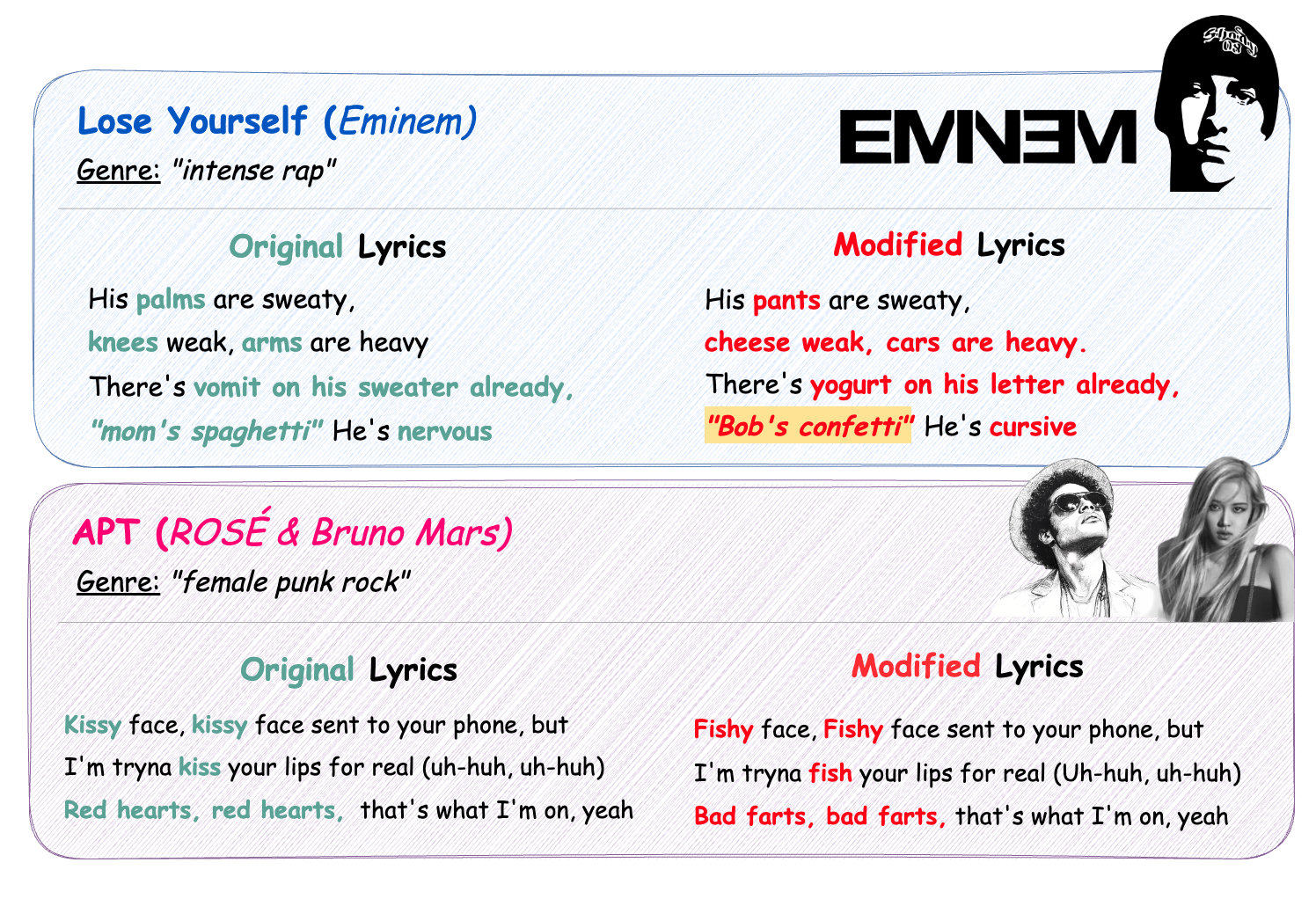
Lyrics-to-Song (L2S) generation models promise end-to-end music synthesis from text, but their vulnerability to copyright leakage remains underexplored. To mitigate this risk, commercial systems typically block prompts containing copyrighted lyrics. In this work, we introduce Adversarial PhoneTic Prompting (APT), an attack that replaces iconic phrases with homophonic alternatives—e.g., "mom's spaghetti" becomes "Bob's confetti"—preserving the acoustic form while bypassing copyright filters.
We reveal that models can be prompted to regurgitate memorized songs using phonetically similar but semantically unrelated lyrics. Despite the semantic drift, black-box models like SUNO and open-source models like YuE generate outputs that are strikingly similar to the original songs—melodically, rhythmically, and vocally—achieving high scores on CLAP, AudioJudge, and CoverID. These effects persist across genres and languages.
More surprisingly, we find that phonetic prompts alone can trigger visual memorization in text-to-video models: when given altered lyrics from Lose Yourself, Veo~3 generates scenes that mirror the original music video—complete with a hooded rapper and dim urban settings—despite no explicit visual cues in the prompt.
Key Findings: Through systematic testing with phoneme modifications (like "mom's spaghetti" → "Bob's confetti"), we demonstrate that AI music models exhibit significant memorization, raising important questions about copyright safety in generative music systems.
Lose Yourself - Veo 3 Video Generation Demo
Demonstration showing how phonetic modifications can trigger visual memorization in text-to-video models.
Original Music Video
Original Lyrics
Phoneme Modified Lyrics
🎤 Rap Phoneme Variants
Hip-hop tracks with phonetic modifications. Key transformations preserve rhythm while changing lyrics.
DNA → BMA (Kendrick Lamar)
Lose Yourself (Eminem)
HUMBLE. (Kendrick Lamar)
🎭 Pop Phoneme Variants
Pop songs with phonetic modifications across different languages.
APT (ROSÉ & Bruno Mars)
Gentlemen (PSY)
Let It Be (The Beatles)
月亮代表我的心 (Teresa Teng)
🎄 Christmas Phoneme Variants
Jingle Bells transformed through phonetic modifications.
Jingle Bell Video Comparison
Original Lyrics
Phoneme-Modified Lyrics
Jingle Bell Audio Variants
Jingle Bell Rock → Giggle Shell Sock
🎵 English (Billboard) Songs
Classic English songs regenerated with genre modifications.
Billie Jean (Michael Jackson)
Original Generated - Inspiring female uplifting popThinking Out Loud (Ed Sheeran)
Original Generated - Male romantic guitar balladEmpire State of Mind
Original Generated - Inspiring female pop🇨🇳 Mandarin & Cantonese Songs
Chinese language songs demonstrating cross-linguistic memorization.
甜蜜蜜 (Teresa Teng)
Original Generated光辉岁月 (Beyond)
Original Generated - Rock nostalgic Cantonese后来 (Hòu Lái) - Rene Liu (Multiple Genre Variants)
BibTeX
@article{roh2025bob,
  title={Bob's Confetti: Phonetic Memorization Attacks in Music and Video Generation},
  author={Roh, Jaechul and Novack, Zachary and Peng, Yuefeng and Mireshghallah, Niloofar and Berg-Kirkpatrick, Taylor and Houmansadr, Amir},
  journal={arXiv preprint arXiv:2507.17937},
  year={2025}
}